

k.p dispersion in bulk unstrained ZnS, CdS, CdSe and ZnO (wurtzite)#
Last update: 2026-04-27
- Files for the tutorial are not available yet
bulk_6x6kp_dispersion_ZnS.nnpbulk_6x6kp_dispersion_CdS.nnpbulk_6x6kp_dispersion_CdSe.nnp
- Files for the tutorial located in nextnano++\examples\electronic_band_structures
bulk_6x6kp_dispersion_ZnO.nnp
Contents
Introduction#
This tutorial shows ow to calculate \(E(k)\) for unstrained bulk ZnS, CdS, CdSe and ZnO, aim to reproduce results of [Jeon1996]. We want to calculate the dispersion \(E(k)\) from \(|k|\) = 0 [1/nm] to \(|k|\) = 1.0 [1/nm] along the following directions in k space:
[000] to [0001], i.e. parallel to the c axis (Note: The c axis is parallel to the z axis.)
[000] to [110], i.e. perpendicular to the c axis (Note: The (\(x\), \(y\)) plane is perpendicular to the c axis.)
We compare 6-band k.p theory results vs. single-band (effective-mass) results.
Bulk dispersion along [0001] and [110]#
classical{
    ...
    bulk_dispersion{
        path{ # dispersion along arbitrary path in k-space
            name = "user_defined_path"
            position{ x = 5.0 }
            point{ k = [0.7071, 0.7071, 0.0] }
            point{ k = [0.0, 0.0, 1.0] }
            spacing  = 0.01                # [1/nm]
            shift_holes_to_zero = yes
        }
    }
}
We calculate the pure bulk dispersion at grid position x = 5.0, i.e. for the material located at the grid point at 5 nm. In our case this is ZnS but it could be any strained alloy.
In the latter case, the k.p Bir-Pikus strain Hamiltonian will be diagonalized.
The grid point inside lines{ position{ } } must be specified.
shift_holes_to_zero = yes forces the top of the valence band to be located at 0 eV.
How often the bulk k.p Hamiltonian should be solved can be specified via lines{ spacing }. To increase the resolution, just increase this number.
The maximum value of \(|k|\) is 1.0 [1/nm].
Note that for values of \(|k|\) larger than 1.0 [1/nm], k.p theory might not be a good approximation any more.
This depends on the material system, of course.
Start the calculation.
The results can be found in the folder bias_00000/Quantum/Bulk_dispersions.
The files bulk_6x6kp_dispersion_as_in_inputfile_kxkykz_000_kxkykz.dat for instance contain 6-band k.p dispersions:
The first column contains the \(|k|\) vector in unitsHere we visualize the results.
The final figures will look like this (left: dispersion along [0001], right: dispersion along [110]):
of [1/nm], the next six columns the six eigenvalues of the 6-band k.p Hamiltonian for this \(k\) = (\(k_x\), \(k_y\), \(k_z\)) point.
The resulting energy dispersion in 6-band k.p theory is usually discussed in terms of a nonparabolic and anisotropic energy dispersion of heavy, light and split-off holes, including valence band mixing.
The single-band effective mass dispersion is parabolic and depends on a single parameter: The effective mass \(m^*\). Note that in wurtzite materials, the mass tensor is usually anisotropic with a mass \(m_{zz}\) parallel to the c axis, and two masses perpendicular to it \(m_{xx}\) = \(m_{yy}\).
Results#
We visualize now the results in Figure 531, Figure 532 and Figure 533. The final figures will look like this (left: dispersion along [0001], right: dispersion along [110]):
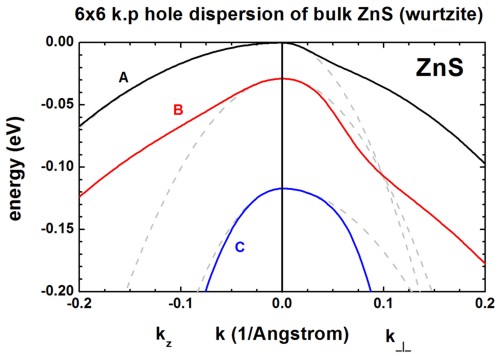
Figure 531 Calculated 1-band (dotted gray) and k.p dispersion of HH (A, black), LH (B, red) and CH (C, blue) valence bands (unstrained).#
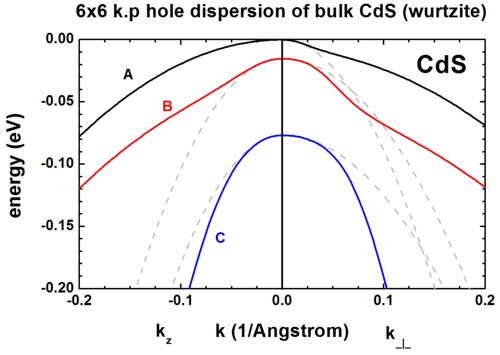
Figure 532 Calculated 1-band (dotted gray) and k.p dispersion of HH (A, black), LH (B, red) and CH (C, blue) valence bands (unstrained).#
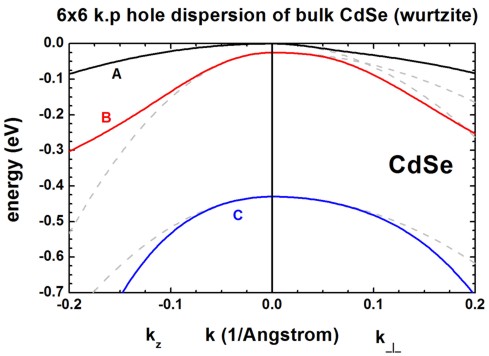
Figure 533 Calculated 1-band (dotted gray) and k.p dispersion of HH (A, black), LH (B, red) and CH (C, blue) valence bands (unstrained).#
These three figures are in excellent agreement to Fig. 1 of the paper by [Jeon1996]. The dispersion along the hexagonal c axis is substantially different from the dispersion in the plane perpendicular to the c axis. The effective mass approximation is indicated by the dashed, gray lines. For the heavy holes (A), the effective mass approximation is very good for the dispersion along the c axis, even at large k vectors.
For comparison, the single-band (effective-mass) dispersion is also shown. For ZnS, it corresponds to the following effective hole masses:
valence_bands{
    HH{ mass_l = 2.23  mass_t = 0.35}   # [m0] heavy hole A  (2.23 along c axis)
    LH{ mass_l = 0.53  mass_t = 0.485}  # [m0] light hole B  (0.53 along c axis)
    SO{ mass_l = 0.32  mass_t = 0.75}   # [m0] crystal hole C  (0.32 along c axis)
}
The effective mass approximation is a simple parabolic dispersion which is anisotropic if the mass tensor is anisotropic (i.e. it also depends on the k vector direction).
One can see that for \(|k|\) < 0.5 [1/nm] the single-band approximation is in excellent agreement with 6-band k.p, but differs at larger \(|k|\) values substantially.
Plotting \(E(k)\) in three dimensions#
Alternatively one can print out the 3D data field of the bulk \(E(k)\) = \(E(k_x, k_y,k_z)\) dispersion.
full{ # 3D dispersion on rectilinear grid in k-space
    name = "3D"
    position{ x = 5.0 }
    kxgrid {
        line{ pos = -1  spacing = 0.04 }
        line{ pos =  1  spacing = 0.04 }
    }
    kygrid {
        line{ pos = -1  spacing = 0.04 }
        line{ pos =  1  spacing = 0.04 }
    }
    kzgrid {
        line{ pos = -1  spacing = 0.04 }
        line{ pos =  1  spacing = 0.04 }
    }
    shift_holes_to_zero = yes
    }
}
k.p dispersion in bulk unstrained ZnO#
Figure 534 shows the bulk 6-band k.p energy dispersion for ZnO. The gray lines are the dispersions assuming a parabolic effective mass.
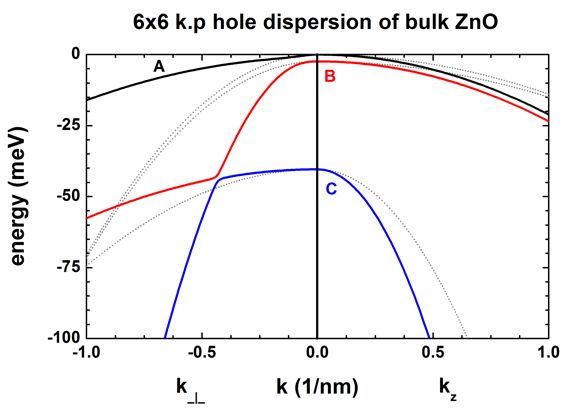
Figure 534 Calculated parabolic effective mass (dotted, gray) and k.p dispersion of HH (A, black), LH (B, red) and CH (C, blue) valence bands (unstrained).#
The following files are plotted:
bulk_6x6kp_dispersion_as_in_inputfile_kxkykz_000_kxkykz.dat
bulk_sg_dispersion.dat
The files
bulk_6x6kp_dispersion_axis_-100_000_100.datand
bulk_6x6kp_dispersion_diagonal_-110_000_1-10.dat
contain the same data because for a wurtzite crystal due to symmetry. The dispersion in the plane perpendicular to the \(k_z\) direction (corresponding to [0001]) is isotropic.