

Electronic band structures of HgTe, CdTe, and of the alloy CdxHg1-xTe#
Last update: 2026-06-02
- Available for our customers upon request.
zb_II-VI_CdHgTe_bulk-bands_JPSJ_Koenig_2008_1D.nnp
- Main adjustable variables
$TEMPtemperature (K)
$x_alloypercentage of Cd in the CdxHg1-xTe alloy
$STRAINtaking strain into account (0 = “no”, 1 = “yes”)
Contents
Introduction#
In this tutorial, we illustrate the general concepts of the topological band theory using two archetypal materials: HgTe and CdTe. These materials are among the most well-known in the physics of topological insulators, largely due to two seminal works in which HgTe and CdTe played a central role - one theoretical [BernevigScience2006] and one experimental [König2007].
We begin by reviewing the well-known properties of the bulk band structures of these materials [König2008]. The relevant bands near the Fermi level are located close to the \(\Gamma\)-point in the Brillouin zone, see Figure 527. These include the s-type band (\(\Gamma_6\)) and the p-type bands, which are split into \(\Gamma_7\) and \(\Gamma_8\) by spin-orbit coupling. CdTe (panel (a) of Figure 527) is a normal insulator (NI) with a conventional band ordering: the s-type \(\Gamma_6\) band forms the conduction band, while the p-type \(\Gamma_7\) and \(\Gamma_8\) bands form the valence bands. Valence and conduction bands are separated by a relatively large energy gap of about 1.6 eV. In contrast, HgTe (panel (b) of Figure 527) exhibits a negative energy gap of approximately -300 meV, indicating that the usual order of the bands is reversed, with the \(\Gamma_8\) band lying above the \(\Gamma_6\) band. In this case, the light-hole subband of \(\Gamma_8\) forms the conduction band, while the heavy-hole subband becomes the top valence band. The s-type \(\Gamma_6\) band is pushed below the Fermi level and lies between the heavy-hole subband and the spin-orbit split-off band \(\Gamma_7\). Due to this unusual ordering of states, the band structure is referred to as inverted. Because the heavy- and light-hole bands are degenerate at the \(\Gamma\) -point, HgTe is a zero-gap semiconductor.
Simulations#
Let us now demonstrate how the results reported in [König2008] for bulk HgTe and CdTe can be reproduced using the nextnano software. We employ the 8-bands \(\mathbf{k} \cdot \mathbf{p}\) model to calculate the band structure, with material parameters taken from [REF].
Figure 527 shows excellent agreement between the results of [König2008] and our simulations. Energy offsets, which do not affect the physical properties, were introduced to match the curves at k=0.
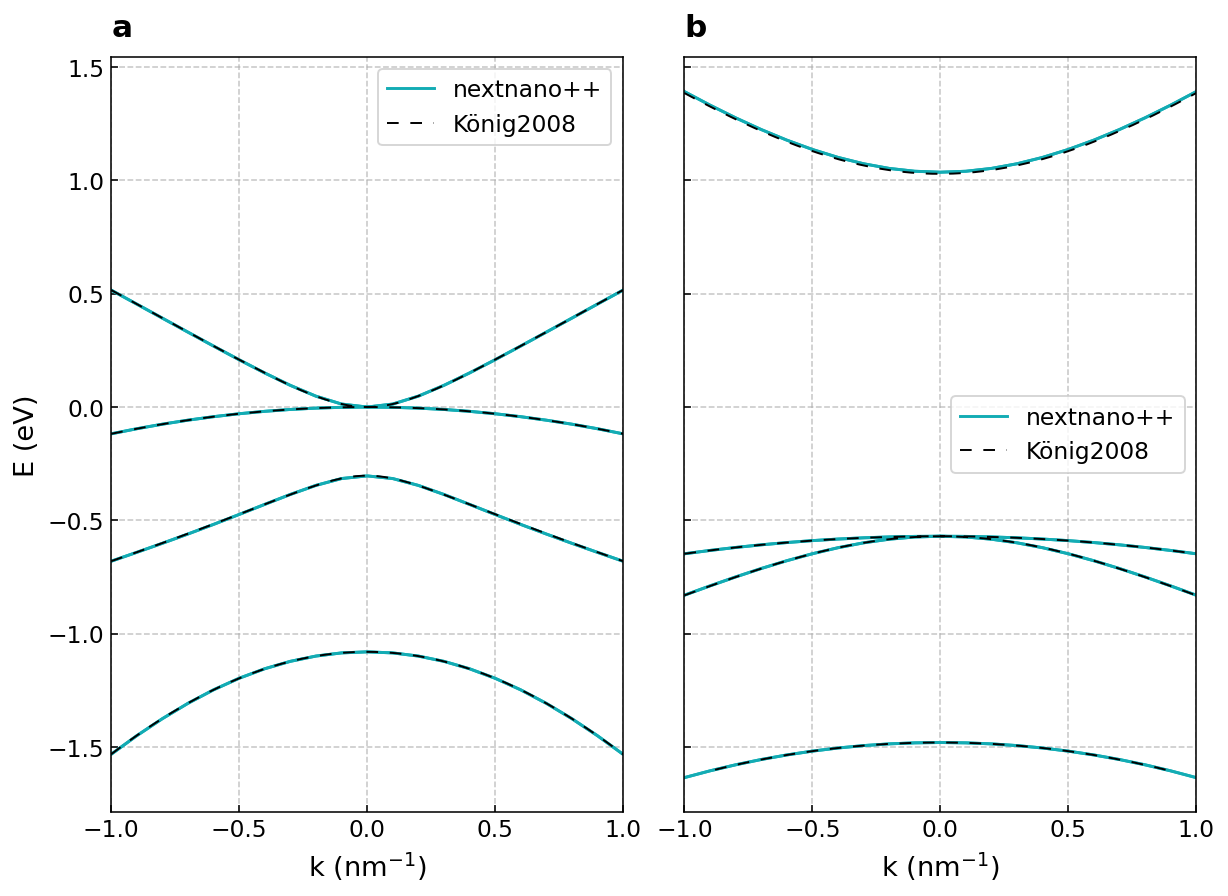
Figure 527 Electronic band structures of bulk (a) CdTe and (b) HgTe calculated using 8-band \(\mathbf{k} \cdot \mathbf{p}\) model.#
Next, we focus on the band structure of the alloy CdxHg1-xTe near the \(\Gamma\) point. As expected, its energy bands approach those of HgTe and CdTe in the limits x→0 and x→1, respectively. When x is varied smoothly between these two extremes, the band structure evolves continuously between the corresponding limiting cases. In particular, there must exist a critical value of x at which the energy gap closes.
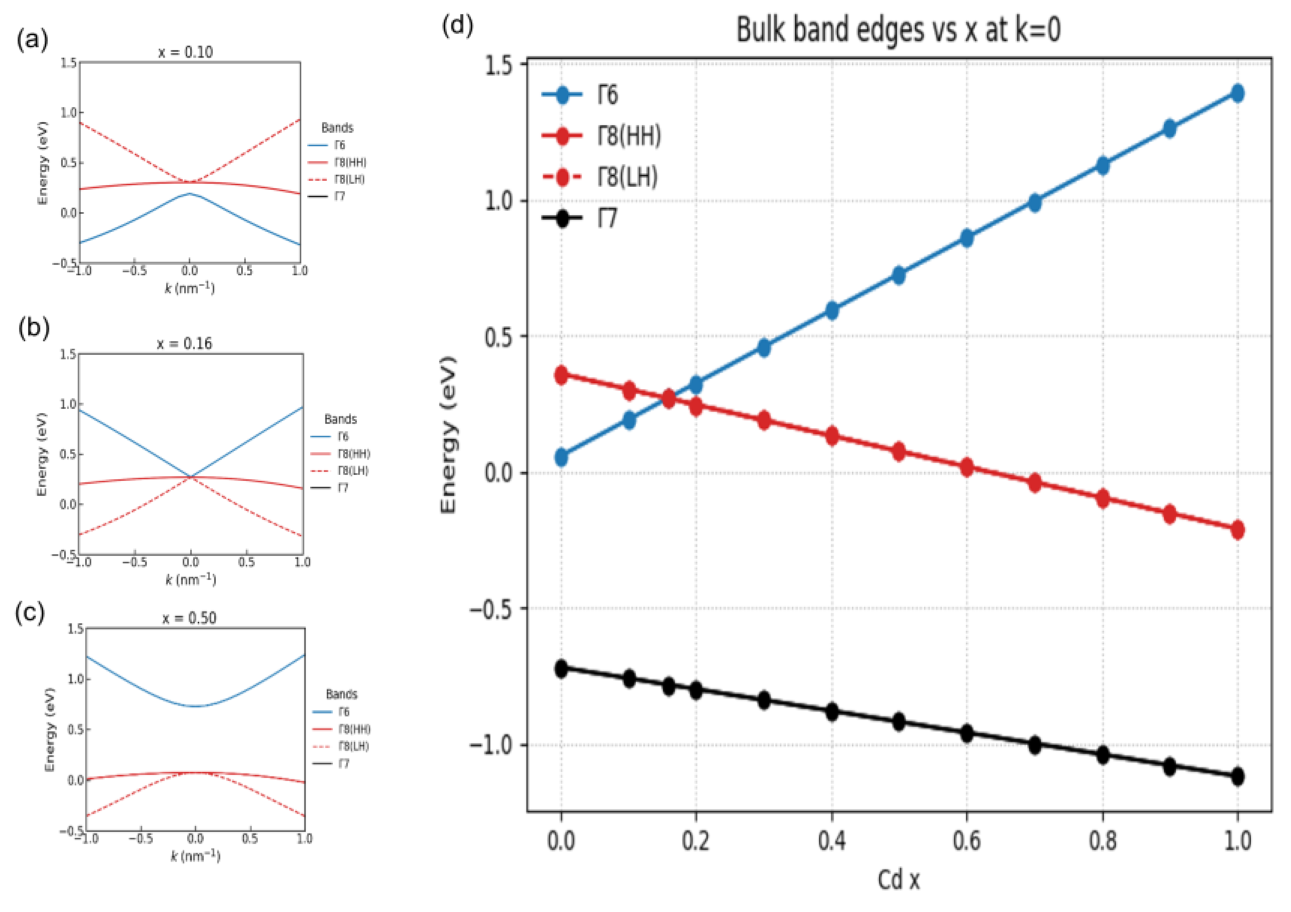
Figure 528 Electronic band structures of bulk (a) Cd0.1Hg0.9Te, (b) Cd0.16Hg0.84Te, and (c) Cd0.5Hg0.5Te calculated using 8-band \(\mathbf{k} \cdot \mathbf{p}\) model. (d) Band edges of the alloy CdxHg1-xTe as the function of the alloy composition \(x\).#
The simulations shown in pannels (a)-(c) of Figure 528 illustrate this behavior. The ordering of the energy bands is similar to that of HgTe at \(x=0.1\) and of CdTe at \(x=0.5\). The gap between the \(\Gamma_6\) and \(\Gamma_8\) bands vanishes at \(x \approx 0.16\). Therefore, this value marks the transition point between alloys with topologically distinct band structures.
Pannel (d) of Figure 528 shows the band edges of the alloy exactly at the \(\Gamma\) point. The point of the topological transition, where the blue and red curves intersect, corresponding to the closing of the energy gap, is clearly visible.
- To practice
Sweep the parameter x and calculate how the gap between the \(\Gamma_6\) and \(\Gamma_8\) bands depends on this parameter. Check whether the sign of the gap changes at the point of the topological transition.
Consider whether the 4-band \(\mathbf{k} \cdot \mathbf{p}\) model could be used for the simulations described in this tutorial. Explain your answer.