

The nextnano Software#
The nextnano software is the simulation software for the next generation of nano devices. It allows modelling electronic and optoelectronic semiconductor nanodevices. It is characterized by:
|
|
|
The nextnano software is typically used for research focused on physics of nanodevices. It can be used for modeling variety of simple structures containing quantum wells, quantum wires, and quantum dots, as well ass more complex systems such as quantum cascade lasers, resonant tunneling diodes, and superlattices. These can be modeled as 1D, 2D, and 3D systems, either as separate structures or as part of a larger devices.
To provide such capabilities, the nextnano software consists of a set of solvers (nextnano++, nextnano³, nextnano.MSB, and nextnano.NEGF) for the Schrödinger, Poisson, and current equations, as well as the Non-Equilibrium Green’s Function (NEGF) formalism. These tools require an input file specifying the structure, models and output data of interest. Together with the solvers, we provide a graphical user interface (nextnanomat) and a Python package (nextnanopy) to facilitate the workflow of simulations and analysis of results. For advanced simulations, we provide a package of optimizers (nextnano optimizers) to interface with the solvers and automate the optimization of device parameters.
The nextnano software license includes access to hundreds of maintained example input files as well as tutorials featuring state-of-the-art physics and publications in semiconductor and quantum science. One can adapt an example file to your device’s geometry to get started with your digital twin without high initial training effort.


The nextnano++ tool is a Schrödinger-Poisson-current solver and simulates quantum wells, quantum wires, quantum dots, …
Features of nextnano++ include:
includes group IV materials (Si, Ge, SiGe) and all III-V materials, its ternaries and quaternaries;
the nitrides are available in the zinc blende and wurtzite crystal structure
flexible structures and geometries (1D, 2D and 3D)
fully quantum mechanical electronic structure, based on the 8-band \(\mathbf{k} \cdot \mathbf{p}\) model
strain, piezo- and pyroelectric charges
growth directions along [001], [011], [111], [211], … in short along any crystallographic direction
equilibrium and non-equilibrium, calculation of current close to equilibrium (semi-classical)
magnetic fields


The nextnano.NEGF tool is designed for accurate quantum simulations of semiconducting devices using the Non-Equilibrium Green Functions (NEGF) formalism. It has been originally developed to simulate electron dynamics and gain in quantum cascade lasers (QCLs) and superlattices. It can also be applied to infrared detectors such as quantum well infrared detectors (QWIPs) and quantum cascade detectors (QCDs), as well as transport in resonant tunneling diodes (RTDs). It is progressively extended to further applications such as interband devices.
The nextnano³ tool is the predecessor of nextnano++


The nextnanomat GUI is a convenient graphical user interface for nextnano++, nextnano³, and nextnano.NEGF. It allows for 1D, 2D and 3D visualizations of computed results. This workflow manager is designed in a general way allowing to run any executables and overview generated output files.


The nextnano optimizers Python package is interfacing minimization and evolution algorithms with nextnano simulation tools: nextnano++, nextnano³, and nextnano.NEGF. The package takes care of proper execution of simulations for optimization algorithms and definitions of problems to optimize based on standard nextnano outputs.


The nextnanopy Python package is developed for nextnano++, nextnano³, nextnano.NEGF and nextnano.MSB tools to automate nextnano simulations and analysis of the results.


The nextnano.MSB tool has been developed for simple simulations of Quantum Cascade Lasers (QCLs) and Resonant Tunneling Diodes (RTDs). The tool calculates current-voltage characteristics and gain.
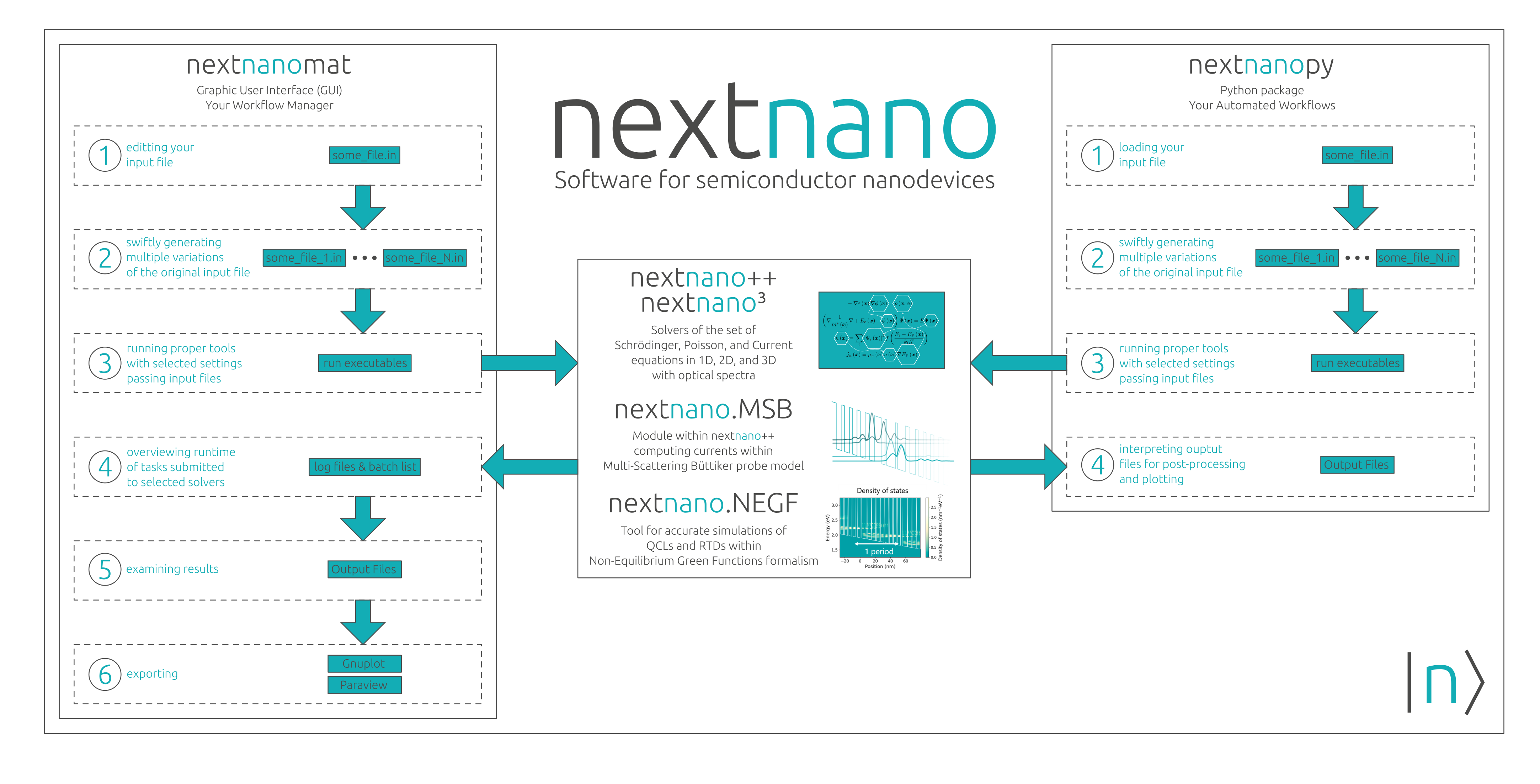
Figure 1 Structure and typical workflow of the nextnano software#
Getting Started#
Support#
FAQs#
Accessibility Statement
The accessibility statement and evaluation report for the nextnano software can be downloaded using the links below: